Tuesday, November 15, 2011

Beautiful Looking Homepage


Designing your own website can be a lot of fun. You get to choose the content and the layout. However, creating a website takes a lot of hard work, to the point where most people get frustrated and give up. This can have negative consequences on the look of your website and especially your homepage. Maybe the vision was good but the execution was not up to the task, so what is one to do? Much like the new Windows 8 that is coming out, and the not as successful Vista, you need to plan your website well!

Here are seven ways to help you get your homepage off the ground and looking great:

1. Quality Content

Spice up your homepage up by featuring quality articles, product reviews or pictures. This has the two fold effect of keeping your loyal users engaged as well as attracting new users to your site. You could also get the same idea as the Windows Eight Downloads for beta testing and trial your content on friends, family and even customers to see what works.
2. Be Creative
Always experiment with new ways of engaging people with your homepage. Try music or animation, or even a short video. Never be bland or generic, new websites need to make a big splash on the crowded online marketplace.
3. Keep Your Links Focused

Your homepage will need several links in order for people to be able to navigate your site. However, make sure the links you include are relevant to your website. Keep the links focused and easy to understand. A link titled ‘About’ is easy to understand because it’s clean and simple. A link containing more than seven words is too loaded and unfocused.
4. Keep it Clean

The best way to create a great looking homepage is to avoid clutter. Big websites, like Amazon, have a massive client base. People will keep going to the site no matter how busy the homepage is. You don’t have that luxury. Keep the homepage clean and simple for now.
5. Limit the Scrollbars

It might be tempting to stuff your homepage full of information so people have everything at their fingertips. However, it can be pretty off putting for people when they are faced with a dozen scrollbars full of content. It can be so daunting that they quickly lose interest and leave your site, so save the content for the inner pages.
6. Keep it Up to Date

Don’t let your homepage lag behind the times. Make sure your homepage receives regular updates to keep people interested. Of all pages that need to be refreshed periodically, your homepage takes precedent because it’s the first thing people will see.
7. Make the Homepage Relevant

You want your website, and especially your homepage, to aesthetically match what you’re trying to sell. If you have a site that features classical music, make sure your homepage isn’t covered with barbed wire graphics. Make sure you register with a robust web hosting service, as they usually provide you with the tools to easily customize your site.

Your homepage is the first thing that people see when they click on your site, and with these seven tips you can make a great looking homepage that is sure to gain a lot of traffic.

Labels: , ,

Saturday, August 28, 2010

Top risky for web surfing "Turkey and Russia"

AVG study looks at the safest and most dangerous places to surf the Internet

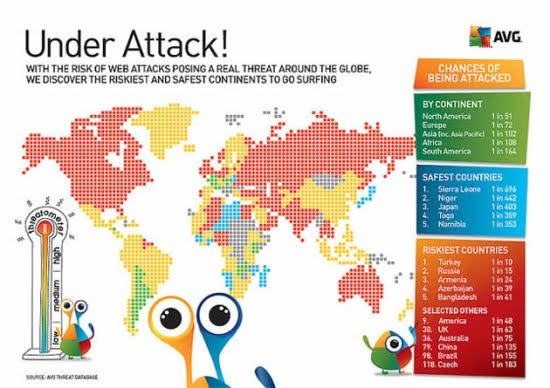
                                                             [Where are the safest and most dangerous places in the world to use the internet? ] 

Where in the World are you most likely to be hit by a malicious computer attack or virus? According to Internet Security company AVG, it’s the Caucasus region, with web surfers in Turkey, Russia, Armenia and Azerbaijan all being the most likely to face threats while online.

At the other end of the scale, some of the world’s safest surfers can be found in Japan and Taiwan, while seven of the 10 safest countries in which to surf the Internet are in Africa. As a continent, South America was ‘safest’, and North America riskiest. Globally your chances of being attacked while online on any given day are 1 in 73.

The data taken from 144 countries, involving over 100 million PCs, enabled AVG to look at the incidence of security threats that its software had to deal with in the last week of July. From these figures, AVG came out with an average for attacks per user per country.
Key results for the last week of July 2010 are as follows:

Turkey leads the league table for risky surfing, with AVG’s software having to step in to protect on average, one in 10 users of the Internet. Web users in Russia (1 in 15 were hit), Armenia (1 in 24), and Azerbaijan (1 in 39) also suffer high rates of attacks.

Other areas where web surfers are disproportionately at risk include Bangladesh (1 in 41), Pakistan (1 in 48) and in SE Asia, Vietnam and Laos (where the chances of facing an attack are both 1 in 42).

What about other major Western countries? The US is at number nine when it comes to the riskiest places to go online (1 in 48) , UK is ranked 31st (1 in 63), Australia 37th (attack ratio = 1 in 75) while German web surfers come in at number 41 (1 in 83).

Sierra Leone had the fewest attacks with on average one in 692 web surfers facing an attack. Niger too fared where just one in 442 surfers on average were attacked, however with low broadband penetration and Internet use in these African countries.

It is because of its high internet use and broadband penetration that Japan, where there is an average of just one in 404 facing an attack, is arguably the safest place to surf the net.

Meanwhile Taiwan (1 in 248 attacked), Argentina (1 in 241 attacked), and France (1 in 224 attacked) all came in the top 20 safe list.
Analyzing the data by continent, your chances of getting attacked while surfing the Web in North America are 1 in 51. In Europe it is 1 in 72, while in Asia (including Asia Pacific) 1 in 102. The safest continents are Africa (1 in 108), and by a long way South America (1 in 164).

While African countries make up seven of the top 10 ‘safe surfing’ list, it’s noteworthy that the chances of being attacked in all South American countries is more than 1 in 100. The ‘riskiest’ country in South America was Peru at 1 in 131, which globally still only ranks 78th out of 142 countries.

According to AVG spokesperson, Roger Thomson, “Our research tells us a lot about the behaviour of web surfers worldwide. Internet users in Turkey, Russia, the Caucasus and South-east Asia for example show disproportionately higher rates of being attacked than the global average of 1 in 73.

“There are a number of reasons for this. Some of it may be down to a tendency to access semi-legal or illegal download sites, while some of it probably is down to being less cautious when it comes to sharing links and files online. Another factor is the popularity of Internet cafes and people generally sharing computers. However, it is safe to say that even in these countries, a minority of users account for a large proportion of attacks.”

“If you look at Japan at the other end of the scale - a country where both Internet use and broadband protection is very high - our software only picked up a web attack for every 403rd user. Our take on this is that Japanese web surfers are generally more aware of safe and risky surfing behaviours.
However, our research should also serve as a wake-up call to people going abroad. If you are travelling without your computer and use a public machine or borrow a friend or colleagues, ensure that when accessing web -based services like email, that you log out and close the browser when you have finished your session.

If you are taking your laptop with you ensure you have backed up your data and removed any sensitive information from your machine.

Finally the key point is that all these web attacks were successfully caught and stopped by ourselves. Even the global average of facing a 1 in 73 attack on any given day does not present great odds if averaged out across a year. Hence the importance of making sure that your computer really does have the right anti-virus software installed.”


Methodology

AVG looked at the number of Internet attacks worldwide for the final week of July 2010, as well as the number of AVG installs per country. From this, AVG was able to work out on average the chances of web surfers being attacked.

This sample was taken in the last week of July. Rankings and order of countries will change over time and is not fixed.
The research involved taking data from over 100 million AVG installations across 144 countries.


Labels: , , , ,